Addressing Marine Debris in the Gulf of Maine
Gulf of Maine Regional Collaboration
The Gulf of Maine Association received a 2021 award from the National Oceanic and Atmospheric Administration’s (NOAA) Marine Debris Program to partner with NOAA, Gulf of Maine Council, Blue Ocean Society for Marine Conservation, Center for Coastal Studies, Huntsman Marine Science Centre, Maine Coastal Program – Maine Department of Marine Resources, Surfrider Foundation, Urban Harbors Institute and the five jurisdictions bordering the Gulf of Maine to create an international collaborative approach for addressing plastic and other marine debris in the Gulf of Maine watershed. Funding for this program was awarded by NOAA’s North America Marine Debris Prevention and Removal Grant program which supported projects that prevent and remove debris in the U.S.-Mexico and U.S.-Canada border areas.
About Marine Debris
Marine debris poses an environmental threat to coastal and ocean ecosystems. Marine debris is defined as any persistent solid material that is manufactured or processed and directly or indirectly, intentionally or unintentionally, disposed of or abandoned into the marine environment. Sources of marine debris include windswept and littered trash, debris from coastal storms, storm water discharges, fishing and other maritime activities. Common types of marine debris include shipping materials, packaging and consumer products; single-use plastics items such as water bottles, straws, foam food ware, cigarette butts, balloons and grocery bags; microplastics; derelict fishing gear; and abandoned and derelict vessels. For additional information, check out NOAA’s Discover Marine Debris resources including:
- What is Marine Debris?
- Why is Marine Debris a Problem?
- Abandoned and Derelict Vessels
- Derelict Fishing Gear
- Microplastic Marine Debris Fact Sheet
- Plastic Marine Debris Fact Sheet
Marine Debris in the Gulf of Maine
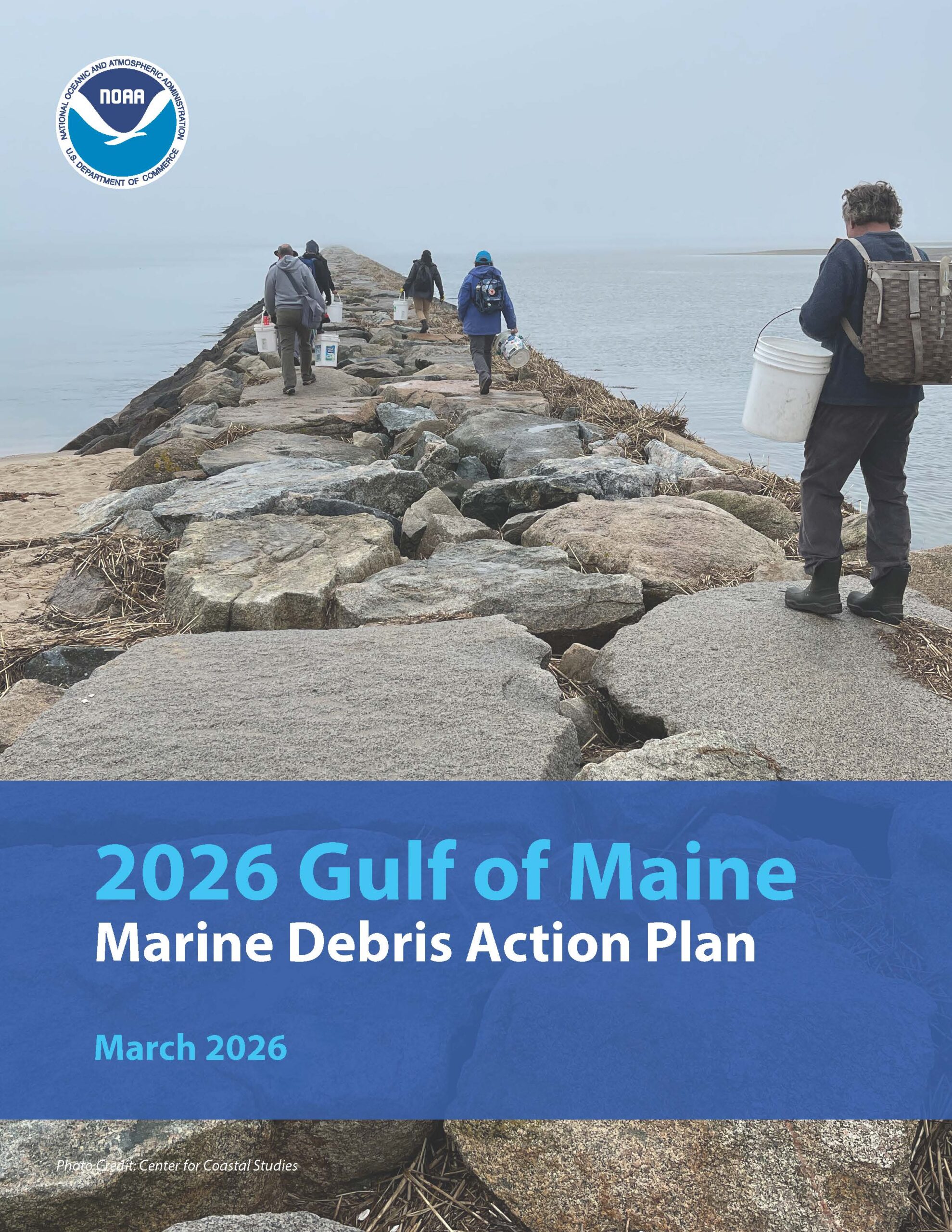 Addressing the environmental problem of marine debris in the Gulf of Maine helps protect valuable habitat for migratory shorebirds, fish, shellfish and marine mammals. Removing marine debris also improves essential fish habitat for species such as Atlantic herring, lobster and crab, Atlantic cod, haddock, and winter flounder. Marine debris prevention and removal efforts also reduce sources of entrapment, entanglement, and ingestion for the multitude of marine animals and birds in the Gulf of Maine. The Gulf of Maine Marine Debris Action Plan provides a framework for guiding voluntary regional efforts to address the environmental problem of marine debris in the Gulf of Maine. The plan was developed through the collaborative effort of more than 30 organizations conducting work in Massachusetts, New Hampshire, Maine, New Brunswick, and Nova Scotia to address marine debris through coordinated actions over five years (2026 – 2031).
About the Program
U.S. and Canadian partners are working together to remove, reduce and prevent the introduction of marine debris in the Gulf of Maine. Project partners are conducting coastal cleanups, tracking marine debris, and reducing the introduction of plastics, fishing gear and other sources of marine debris before they harm marine mammals and damage fisheries, ocean and coastal habitats, recreation areas, and other natural resources in the Gulf of Maine. Project accomplishments have been highlighted through a variety of outreach activities, including:
- Regional Collaboration to address Marine Debris in the Gulf of Maine. GOMA Marine Debris 2024 Final Report.
- Regional Collaboration to Address Marine Debris in the Gulf of Maine, Poster (updated July 2024). View the poster here.
- Webinar – Regional Collaboration to Address Marine Debris in the Gulf of Maine – January 30, 2024
- View the webinar recording here (captions available)
- View the presentations from the webinar
- Regional Collaboration to Address Marine Debris in the Gulf of Maine, J. LeBlanc, GOMC; D. Fox and D. Kamberalis, NOAA
- International Collaboration Helps Address Marine Debris, L. Ludwig, Center for Coastal Studies
- Innovative Opportunities to Collect and Repurpose Marine Debris, N. Waaler, Huntsman Marine Science Centre
- Field Guide to Marine Debris in the Gulf of Maine, K. Starbuck, Urban Harbors Institute
- How Cleanups Inform Prevention Efforts, J. Kennedy and M. Ghirardi, Blue Ocean Society for Marine Conservation
- Partnering with Businesses to Make a Difference, I. DeFrancesco, Surfrider Foundation
- June 2023 presentations at the Gulf of Maine Council meeting, Boston, Massachusetts.
- Regional Collaboration to Address Marine Debris in the Gulf of Maine, D. Fox, NOAA
- Fishing Line Recycling, D. Kamberalis and J. Kennedy, Blue Ocean Society for Marine Conservation
- Found Objects Contest, I. DeFrancesco, Surfrider Foundation
- Marine Debris Art, L. Ludwig, Center for Coastal Studies
- Microplastics Research, Urban Harbors Institute, UMass Boston
- Repurposing Marine Debris, N. Waaler, Huntsman Marine Science Centre
- Blog highlighting experience of project team members at 7IMDC, 7th International Marine Debris Conference in Busan, Republic of Korea. View the blog here.
- Project highlights in May 2022 blog post hosted by the NOAA Marine Debris Program: View the blog here.
- December 2021 presentation to the Gulf of Maine Council. View the presentation here.
Take Action

- Check our calendar for upcoming cleanups and events in your area.
- Conduct your own DIY cleanup using this Digital Cleanup Kit.
- Use this Field Guide to Marine Debris in the Gulf of Maine to help identify marine debris items and inform efforts to reduce sources of marine debris.
- Find out how your restaurant can reduce pollution by becoming an Ocean Friendly Restaurant.
- Learn about yellow shock tubing washing up on area beaches and send reports to lludwig@coastalstudies.org
Follow Us on Social Media


#DebrisFreeGulfofMaine
Program Contacts
- Jen Kennedy, Blue Ocean Society for Marine Conservation
jen@blueoceansociety.org - Laura Ludwig, Center for Coastal Studies
lludwig@coastalstudies.org - Joan LeBlanc, Gulf of Maine Association / Gulf of Maine Council
jleblanc@gulfofmaine.org - Nicole Waaler, Huntsman Marine Science Centre
Nicole.Waaler@huntsmanmarine.ca - Theresa Torrent, Maine Department of Marine Resources, Maine Coastal Program
theresa.torrent@maine.gov - Demi Fox, NOAA Marine Debris Program
demi.fox@noaa.gov - Isabella DeFrancesco, Surfrider Foundation
idefrancesco@surfrider.org - Kimberly Starbuck, Urban Harbors Institute, University of Massachusetts Boston
kimberly.starbuck@umb.edu
Partners


